Statute
Na temelju članka 13. Zakona o udrugama („Narodne novine" broj 74/14), Skupština udruge: KPD Bratska sloga, na sjednici održanoj dana 17. svibnja 2015. donijela je S T A T U T E udruge: KPD BRATSKA SLOGA.
On this page we publish the entire text of the Statute, from Article 1 to Article 37, without omitting individual provisions.
Editor's note: the source numbers its sections with Roman numerals, and in that series two sections carry the number V - "Cessation of the Association" and "Property and how it is acquired". We keep the original numbering untouched, without renumbering. The article numbers (1 - 37) are authoritative, not the Roman numerals of the sections.
I GENERAL PROVISIONS
Article 1.
This Statute regulates the provisions on
- the name and the registered seat,
- representation,
- the appearance of the Association's seal,
- the field of activity in accordance with the goals,
- the goals
- the activities through which the goals are achieved,
- the economic activities in accordance with the law, if it performs them
- the manner of ensuring the public nature of the Association's work,
- the conditions and manner of joining and of the termination of membership,
- the rights and obligations and liability, the disciplinary liability of members and the manner of keeping the register of members,
- the bodies of the Association,
- their composition and the manner of convening sessions,
- the election, removal, powers, manner of decision-making and term of office, and the manner of convening the Assembly in the event of the expiry of a mandate;
- the election and removal of the Association's Liquidator
- the cessation of the existence of the Association
- the property, the manner of acquiring and disposing of property
- the procedure for handling property in the event of the cessation of the Association
- the manner of resolving disputes and conflicts of interest within the Association.
Article 2.
The name of the Association is: Cultural-Educational Society Bratska sloga
The Association was founded in 1911 as the reading room Bratska sloga
The shortened name of the Association is: KPD Bratska sloga
The registered seat of the Association is: Žrnovo – Postrana.
The Association is represented by the President of the Association.
The President may also authorise other persons to represent the Association.
Article 3.
An association within the meaning of this Act is any form of free and voluntary association of several natural or legal persons who, in order to protect their material interests or to advocate for the protection of cultural, educational, sports, professional or other beliefs and goals that are not contrary to the Constitution and the law, and without the intention of acquiring profit or other economically assessable benefits, submit themselves to the rules governing the organisation and operation of that form of association.
The Association is registered with the administrative office of Dubrovnik-Neretva County. The Association is a non-profit legal person.
Article 4.
The Association has a seal.
The seal of the Association is rectangular in shape, with the inscription: KULTURNO PROSVJETNO DRUŠTVO BRATSKA SLOGA.
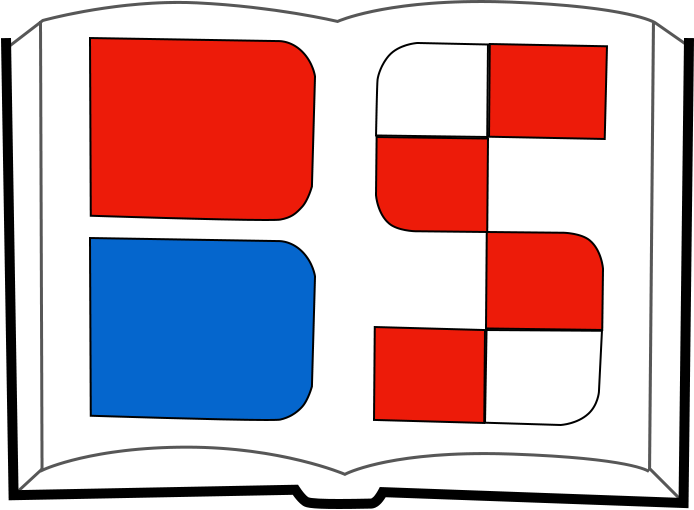
The Association has an emblem. The emblem of the Association represents an open book with stylised letters B and S. The letter B is red-white-blue in colour, and the letter S is red-white.
The Association's Day is marked on August 15.
II FIELDS OF ACTIVITY, GOALS AND ACTIVITIES OF THE ASSOCIATION
Article 5.
The field of activity of the Association, in accordance with its goals, is: the cultivation and promotion of forms of cultural and educational expression based on the traditions of the Croatian people, but also of valuable cultural achievements of other nations, through the following forms:
- the preparation and public performance of its own programs,
- encouraging young people to volunteer and to take an active part in the community
- organizing and hosting exhibitions, public discussions, workshops, performances, and musical and sports events
- informing the public about its work through the media
- publishing publications and periodicals with content from the field of its activity
- promoting and researching the ethnological values of the local environment
- work on breaking down age, gender, educational, cultural, national, religious and racial barriers
- spreading love and shared responsibility for nature and raising ecological awareness of the values of one's homeland founded on traditional customs
- the organization of international meetings in the form of seminars or symposia
- the organization of guest appearances by foreign associations with the same activity content
- spreading a culture of communication among people
- promoting tourist values in local communities
- the production of tourist guides with the cultural, historical, sports and entertainment content of particular locations
- to develop health culture through tourist walks and light excursions
- using the knowledge and life experience of the older members of the Association, who through seminars, lectures and the passing of experience on to other members
Article 6.
The activities of the Association through which the goals in Article 5 are achieved will be carried out by its own efforts, by its membership, by professional support and by collected material resources. In achieving its goals the Association organises itself through sections.
The sections of the Association are:
- the folklore section MOŠTRA,
- the entertainment and sports section
- the workshop section
- the media section
- the cultural, organizational and promotional section
- the ecological and health section
- the music section
- the drama section
Sections that are not included in the Association's outline plan may be added subsequently if the Management Board of the Association assesses that they can be realised.
Article 7.
Pored djelatnosti kojima se ostvaruju ciljevi utvrđeni Statutom udruga obavlja economic activities na temelju odluke Upravnog odbora, sukladno posebnim propisima kojima se uređuju uvjeti za obavljanje te vrste djelatnosti. (Čl. 31. st. 1 Zakona o udrugama)
Article 8.
The work of the Association is public. The public nature of the Association's work is realised in the ways laid down by this Statute, in particular:
- by reporting to the membership in good time on the work of the Association and on significant events, by written reports, at special gatherings or in another appropriate manner,
- by public announcements.
All members of the Association have the right to participate in the work of the Association, in accordance with the provisions of the Statute and the law, and the right to inspect the work of the bodies and the decisions that its bodies adopt.
Sessions of the bodies of the Association are public, except in exceptional cases for the protection of the interests of minor members and where this is prescribed by law and other regulations for the special protection of minors.
III MEMBERSHIP IN THE ASSOCIATION
Article 9.
Members of the Association may become natural and legal persons with legal capacity, in accordance with this Statute and the Act.
Legal persons realise their membership in the Association through an authorised representative appointed by the person authorised to represent the legal person.
Members of the Association may also become persons under the age of 14, for whom the legal representative or guardian gives a written declaration of joining the Association, while for persons who have reached the age of 14 the legal representative or guardian gives a written
Membership in the Association may be regular or honorary.
Article 10.
Regular members of the Association may become the persons referred to in paragraph 4 of Article 9 of the Statute who are interested in the work of the Association and who accept the provisions of this Statute and of the other general acts of the Club.
Regular members sign a membership application form by which they undertake to participate in the work of the Association and to respect the provisions of its Statute and other acts, as well as the decisions of the Association's bodies.
The Management Board will adopt the decision on the membership fee.
An honorary member of the Association may become any natural or legal person who has contributed in particular, through personal work and effort, to achieving the goals of the Association.
The Assembly adopts the decision on admission to honorary membership on the proposal of the Management Board!
Any natural or legal person may become a member of the Association, in accordance with the law and the Statute.
A legal person realises its membership in the Association through an authorised representative, appointed by the person authorised to represent the legal person.
Members of the Association may also become persons under the age of 14, for whom the legal representative or guardian gives a written declaration of joining the Association, while for persons who have reached the age of 14 the legal representative or guardian gives written consent.
A person becomes a member of the Association by entry in the list of members kept by the Secretary of the Association.
The list of members is kept electronically and must contain the following data:
- the personal name (designation)
- the OIB
- the date of birth
- the date of joining the Association
- the category of membership
- the date of the termination of membership in the Association, and
- other data.
Article 11.
The rights and obligations of members are:
- to vote and to be elected
- payment of the membership fee
- engaging in the activities of the Association,
- participating in the management of the Association's affairs,
- protecting and enhancing the reputation of the Association,
- to oversee the work of the Association
- safeguarding material assets and fulfilling assumed obligations.
Article 12.
Membership in the Association ends:
- by voluntary withdrawal
- by exclusion
- by non-payment of the membership fee, if the Management Board confirms that decision
- by death
A member of the Association may be excluded from membership if he or she violates the provisions of the Statute or endangers the interests of the Association or causes serious damage to the Association and its membership.
The decision on the exclusion of a member from the Association is adopted by the Management Board. An excluded member has the right to lodge an appeal with the Assembly of the Association within fifteen days, counted from the day of delivery of the decision.
The Assembly is obliged to decide on the appeal within 30 days counted from the day of delivery of the appeal. The decision of the Assembly of the Association on exclusion is final.
IV BODIES OF THE ASSOCIATION
Article 13.
The bodies of the Association are:
- the Assembly,
- the President
- the Vice-President
- the Management Board
- the Secretary
- the Treasurer
- Supervisory Board
- the Liquidator
ASSEMBLY
Article 14.
The Assembly is the highest governing body of the Association. The Assembly consists of all members of the Association with legal capacity or of their representatives elected in the manner prescribed by the statute of the Association. Adult persons deprived of legal capacity take part in the work of the Assembly and may decide at the Assembly.
Minor persons who are members of the Association and have reached the age of 14 may decide at the Assembly with the written consent of the legal representative and guardian.
Article 15.
The Assembly may be regular, electoral or extraordinary. The Assembly meets in regular session once in the course of a year, while the electoral session of the Assembly is held every 4 years.
Sessions of the Assembly are convened by the President of the Association on their own initiative.
In the decision to convene the Assembly, the President sets the agenda of the session, and the day and place of the session.
The President is obliged to convene a session of the Assembly when at least 1/3 of the members of the Association so request.
In their request to convene the Assembly, the proposers are obliged to propose the agenda of the session. If the President does not convene a session of the Assembly within 15 days of the day of delivery of the request in paragraph 5 of this Article, the proposer will convene it (the decision must contain the proposal of the agenda, and the place and day of the session).
At an extraordinary session of the Assembly, decisions are taken only on the questions for which the session was convened.
U slučaju the expiry of a mandate, ostavke ili smrti predsjednika Udruge, izbornu sjednicu Skupštine može sazvati Upravni odbor ili najstariji član udruge.
Article 16.
An extraordinary session is convened by the Management Board at the request of at least one third of the members of the Association. The decision to convene the Assembly states the agenda, the time and the place of the session.
If the Management Board does not convene the Assembly within 30 days of receiving the request, the proposer convenes it.
An extraordinary session considers only the questions placed on the agenda.
The Electoral Assembly is convened by the Management Board. At the start of the Electoral Assembly the working presidency determines how it will conduct its business by adopting the Rules of Procedure of the Electoral Assembly.
The regular Assembly is convened and chaired by the President of the Association. In the President's absence the Assembly is chaired by the Vice-President, and in the Vice-President's absence the person who will chair the session is determined by open vote at the start of the session.
Minutes are kept of the session and are preserved permanently in the archive of the Association.
Article 17.
The Assembly decides validly if a majority of all members of the Assembly is present; if a majority is not present, the Assembly is adjourned for half an hour and then continues its work and adopts decisions by a majority of the members present.
Article 18.
The Assembly of the Association:
- adopts the statute of the Association and its amendments and additions,
- elects and removes the persons authorised to represent
- elects and removes the bodies of the Association
- elects and removes the Liquidator of the Association
- decides on joining unions, communities, networks and other forms of linking between associations
- adopts the work plan and the financial plan for the following calendar year and the report on work for the previous calendar year
- adopts the annual financial report
- decides on changes to the goals and activities, on the termination of work and on the distribution of the Association's remaining property
- decides on a change of the registered seat and a change of the appearance of the Association's seal
- adopts the decision on status changes of the Association
- decides on the resolution of disputes and conflicts of interest within the Association
- and also decides on other matters for which the statute does not establish the competence of other bodies of the Association.
PRESIDENT
Article 19.
The President of the Association is elected and removed by the Assembly for a term of four years.
The President of the Association:
- represents the Association
- convenes sessions of the Assembly
- is responsible for the legality of the Association's work
- conducts the affairs of the Association in accordance with the decisions of the Assembly
- submits the proposal of the annual financial report to the Assembly
- delivers the minutes of the regular session of the Assembly to the competent office of state administration
- decides on a change of the address of the registered seat
- concludes contracts and performs other legal acts in the name and for the account of the Association
- performs other tasks in accordance with the law, the statute and the acts of the Association.
Article 20.
The President is answerable to the Assembly of the Association for their work.
The President submits an annual report on their work to the Assembly of the Association.
In the event of absence or inability to act, the Vice-President stands in for the President in all matters.
MANAGEMENT BOARD
Article 21.
The Management Board is made up of the President, the Vice-President, the Secretary and 10 members.
The Management Board has 13 members elected by the Assembly, with the President of the Association chairing the Management Board by virtue of office.
The Management Board prepares the sessions of the Assembly and decides on the business activities the Association will carry out.
SECRETARY
Article 22.
The Secretary of the Association is elected and appointed by the Assembly for a term of four years to perform the professional and administrative business of the Association.
The Secretary of the Association keeps the register of members.
Supervisory Board
Article 23.
The Supervisory Board has three members. They are elected by the Assembly for a term of four years.
No member of the Management Board may sit on the Supervisory Board.
LIQUIDATOR
Article 24.
The Liquidator of the Association is elected and removed by the Assembly.
The Liquidator may be a natural person or a legal person who is not a member of the Association.
The Liquidator is not entitled to reimbursement of expenses for their work.
The Liquidator represents the Association in the liquidation proceedings and, once those proceedings are opened, is entered in the register of associations as the person authorised to represent the Association until the proceedings end and the Association is struck from the register.
Article 25.
For work in particular fields of the Association's activity, the Assembly or the President may establish standing and ad hoc commissions or other working bodies.
The decision establishing a commission or working body sets out its composition, its tasks, the period for which it is established and its responsibility for the business it carries out.
Article 26.
The Association may join a union, community, network, coordination or other form of association regardless of its field of activity.
The Association may become a member of international associations and organisations.
V CESSATION OF THE ASSOCIATION
Article 27.
The grounds on which the Association ceases to exist are:
- a decision of the Assembly on the cessation of the Association
- affiliation to another association, merger with another association, division of the Association by separation
- the lapse of twice the time foreseen for holding a regular session of the Assembly, when that session has not been held
- a final decision of a court on the abolition of the Association
- the opening of bankruptcy proceedings
- at the request of a member, if the number of members has fallen below the number of founders required to establish an association, and the competent body has not adopted a decision on admitting new members within one year.
Where the Association ceases to exist on the basis of a decision of the Assembly, that decision is adopted by a two-thirds majority of votes of all members of the Assembly of the Association.
V PROPERTY AND METHOD OF ACQUIRING PROPERTY
Article 28.
The property of the Association consists of:
- funds received by the payment of membership fees,
- voluntary contributions and donations
- funds from carrying out the activities through which the goals are achieved
- carrying out economic activities
- the financing of the Association's programs and projects from the state budget and the budgets of units of local self-government, and from funds
- movable assets,
- immovable property,
- other property rights.
The Association may dispose of its property only to pursue the objectives and carry out the activities set by the Statute, in accordance with the law.
Article 29.
If the Association runs programmes and projects of general interest funded from public sources, it must report at least once a year on its work, the scope and the manner of acquiring and spending the funds to the provider of those funds, and inform the wider public through its website.
Funds collected in advance may be used by the Association exclusively to run the approved programmes or projects.
VI DISPOSAL OF ASSOCIATION PROPERTY IN CASE OF CESSATION
Article 30.
If the Association ceases to exist, its property, after creditors and the costs of liquidation, court and other proceedings have been settled, is transferred to an association, institution or foundation with the same or similar statutory objectives, on the basis of a decision of the Assembly adopted in accordance with the Statute.
The Association has no right to divide its property among its founders, its members, the persons authorised to represent it, its employees or persons connected to them.
VII DISPUTE RESOLUTION AND CONFLICT OF INTEREST WITHIN THE ASSOCIATION
Article 31.
A dispute or conflict of interest exists in the Association where the rights and interests of members about which members may freely debate, and which affect the work of the Association as a whole, are at stake, or where the matter concerns questions of common interest to the members.
To resolve disputes and conflicts of interest the Assembly appoints an arbitration panel from among the members of the Association. The composition, term and decision-making of the panel are set by rules of procedure adopted by the Assembly. In its work the arbitration panel applies the provisions of the Conciliation Act as appropriate.
The decision of the arbitration panel is final. Where a dispute or conflict of interest arises over questions for which an application to enter changes in the register of associations is filed and the competent administrative body decides on them, the dissatisfied member first turns to the Association to resolve the dispute. Once the decision of the arbitration panel becomes final, the Association files the application to enter changes in the register of associations together with that decision.
VIII FINANCIAL OPERATIONS OF THE ASSOCIATION
Article 32.
The Association must keep business books and draw up financial reports in accordance with the regulations governing the financial operations and accounting of non-profit organisations.
IX LIABILITY FOR OBLIGATIONS AND DAMAGE
Article 33.
The Association is liable for its obligations with its entire property. The members of the Association and the members of its bodies are not liable for the obligations of the Association.
Bankruptcy proceedings may be opened against the Association, in accordance with the law. The Association and the persons authorised to represent it are liable for damage caused within the Association, or by the Association towards third parties, under the general rules on damage.
X SUPERVISION
Article 34.
The members of the Association supervise its work themselves.
If a member considers that the Association has breached the Statute or another general act of the Association, that member is entitled to draw the attention of the competent body of the Association to it and to demand that the irregularity be remedied.
If the warning is not considered within 30 days of the written request being delivered, and the request is not acted upon and the irregularity not remedied within a further 30 days, the member may bring an action before the municipal court with jurisdiction over the Association's registered seat.
XI STATUS CHANGES
Article 35.
The Assembly decides on changes of status by a majority of the members of the Association.
Affiliation or merger may not be carried out with an association whose financial reports show a negative result.
XII TRANSITIONAL AND FINAL PROVISIONS
Article 36.
The Statute of the Association, and its amendments and additions, are adopted by the Assembly by a majority of votes of all members of the Assembly of the Association, after a debate has been held.
The interpretation of the provisions of this Statute is given by the Assembly of the Association.
The interpretation of the other acts of the Association is given by the President of the Association.
Article 37.
This Statute enters into force on the day it is adopted and applies from the day it is certified by the competent body of state administration.
On the entry into force of this Statute, the Statute adopted by the Assembly at its session of 11 January 1998 ceases to apply.
In Zrnovo-Postrana, 17 May 2015.
Predsjednik Udruge
Frano Cebalo, President of the Association